Image gallery of the sanctuary
Discover the architectural beauty and natural setting of the Sanctuary of the Virgen de la Fuente in Peñarroya de Tastavins through these images showing its evolution and charm.
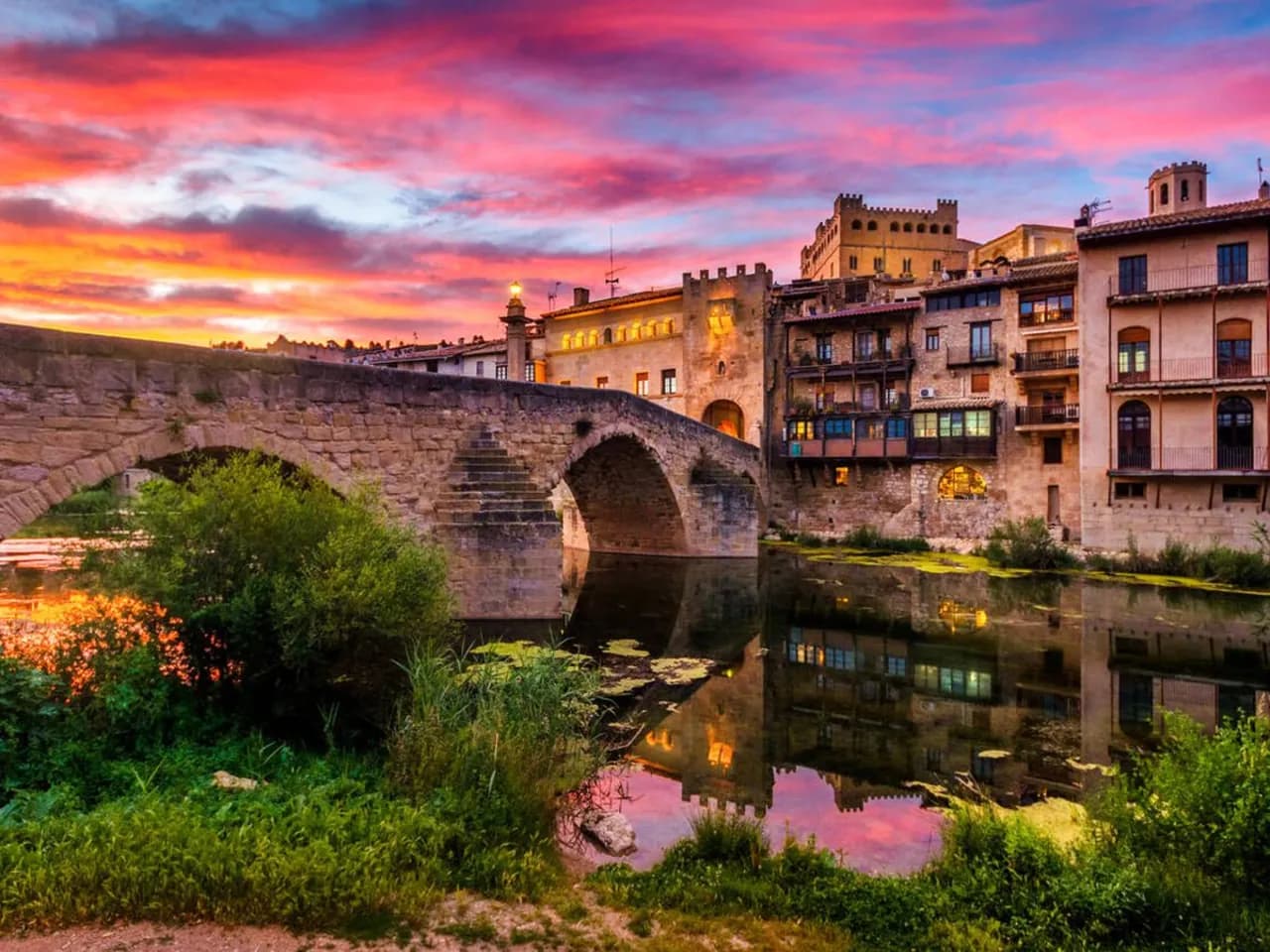
An architectural complex spanning different periods and styles, from medieval Gothic to Baroque, at the heart of the Matarraña region.
The Sanctuary of the Virgen de la Fuente, in Peñarroya de Tastavins, stands in a setting of great natural beauty, linked to the legendary apparition of the Virgin. This architectural complex is a fascinating journey through different eras.
In the highest part, we find the oldest construction: a hermitage (chapel) of Gothic style dating from the 14th century. This architectural gem has withstood the test of time, serving as a silent witness to the rich history of the sanctuary and the Matarraña region.
Adjoining the Gothic hermitage stands the guesthouse (hospedería), a U-shaped building which, with its inner courtyard and arcades, recalls a cloister. Built between the 16th and 17th centuries, it has been extended over time, creating a harmonious, enclosed ensemble.
At a lower level, where the spring that gave rise to the sanctuary wells up, a larger hermitage in Baroque style was built in the 17th century. This incorporates the fountain into its structure, with a rectangular body opened by arcades. An imposing staircase connects these two periods and styles, bridging the elevation gain and joining the different parts of the complex. In short, the Sanctuary of the Virgen de la Fuente is a testament to architectural evolution, from medieval Gothic to Baroque, a place of faith and art at the heart of the Matarraña region.
Discover the architectural beauty and natural setting of the Sanctuary of the Virgen de la Fuente in Peñarroya de Tastavins through these images showing its evolution and charm.
The Sanctuary of the Virgen de la Fuente is a fascinating architectural complex that blends the medieval Gothic of its oldest hermitage with the Baroque splendour of its 17th-century hermitage. At a lower level, where the spring gave rise to the devotion, the Baroque hermitage is integrated with the fountain, opened by elegant arcades. A majestic staircase bridges the elevation gain, harmoniously uniting both parts and styles, demonstrating an architectural evolution that has enriched this sacred place over the centuries in Peñarroya de Tastavins.
The Sanctuary of the Virgen de la Fuente is made up of a group of buildings, among which the upper hermitage stands out. Adjoining the hermitage, a cloister was laid out, surrounded by buildings that today house a guesthouse (hospedería), the Tourist Office and the Interpretation centre of Porcino. Outside this precinct, connected to it by two entrances, stands the lower hermitage, in Baroque style, with a portico on the outside of the apse from which a spring with fifteen spouts flows.
Among the rich collection of legends and traditions of the town of Peñarroya de Tastavins, the one surrounding the origin of this sanctuary is one of the most cherished and deep-rooted. This first construction suffered major damage from the flooding of the river and in 1341 the brotherhood (cofradía) of the Virgin of la Fuente was founded to build a new hermitage higher up, the present Gothic hermitage. The first member of the brotherhood was King Pedro IV of Aragon, who visited the hermitage that same year.
The influx of pilgrims and visitors grew steadily and in the 16th century it was decided to build an adjoining guesthouse (hospedería) and a new hermitage, the lower one, with walls to protect it from the river. It should be noted that this last construction was not completed until the end of the 18th century, at which point the new hermitage replaced the earlier one for religious services.
The upper hermitage is the oldest building preserved at the sanctuary. Its construction began in 1341, after the original hermitage, built the previous century and located lower down, where according to legend the Virgin was found, had suffered flood damage.
The Gothic decoration that survives is of great richness. On the capitals of the archivolts of the doorway, numerous scenes from the New Testament are depicted in the manner of a continuous frieze; on the left side: the Wedding at Cana, the Annunciation to the Shepherds, the Presentation at the Temple, the Flight into Egypt and the Dream of Joseph; and on the right: Jesus on the cross, the Healing of the Woman with the Issue of Blood and the Adoration of the Magi. The figures on either side of the Virgin crowning the arcade most probably represent figures of the Order of Calatrava, which governed the town.
The Mudéjar wooden ceiling is one of the most impressive examples of Aragonese Mudéjar woodwork. It features interesting decoration in which the cross of Calatrava and other heraldic motifs stand out, accompanied by human faces of great stylistic simplicity.
The Mudéjar wooden ceiling covering the five bays of the nave shows a different arrangement in the first two bays of the apse from that in the last three. It is a double-pitched roof, although its structure is not strictly of the parhilera type, since it is essentially supported by four robust arcos diafragma; in reality, structurally, it is like an alfarje laid out on the inclined plane of both pitches, using jácenas as main beams in the longitudinal direction, which bear on the arcos diafragma, while the secondary ones or jaldetas take on the arrangement of the pares or alfardas in the parhilera framework, in the manner of sloping skirts. Aragonese Mudéjar woodwork is characterised by the habitual use of flat ceilings or alfarjes, and here their structure is used to cover, over arcos diafragma, the inclined planes of both pitches, which allows the use of smaller-section timbers.
The last three bays of the nave do not feature the false ridge beam of the first two, but instead close their upper part with a false almizate or harmeruelo, showing in this section the inner profile of par y nudillo ceilings, in the manner of an inverted trough. The fourth bay from the apse, to which the entrance door opens on the south side, giving it the greatest natural light, concentrates the most carefully crafted decoration: its false almizate is achieved by means of four-octagonal interlacing forming eight-pointed stars combined with crosses, all of it not apeinazado but labrado in the wooden boards, in the ataujerado manner, while in the skirts of this bay the boarding that closes it is decorated with six-interlacing, for the decoration of which the wood has been agrimilado in the same way as the walls in the decoration of the surfaces.
Thus, from a structural and decorative point of view, this techumbre of Peñarroya de Tastavins is quite removed from the structural complexities of the carpintería de armar of Almohad tradition, analysed in the par y nudillo framework of the techumbre of the cathedral of Teruel, corroborating the formation of a regional school of Mudéjar woodwork in Aragon, in which the simple structural formulas of the alfarjes predominate, as well as ataujerada and applied decoration. The door of the hermitage, with two leaves, is decorated in the same way as the false almizate of the fourth bay.
Gonzalo Borrás Gualis states that the complex is an example of the greatest interest, already distinguished by its Mudéjar woodwork within the structures of Levantine Gothic architecture. It is an important manifestation of an evolutionary process in which Aragonese Mudéjar woodwork has become isolated from the great workshops of Almohad tradition, developing a distinctive character marked by structural and ornamental simplicity, adapting admirably to the artistic environment in which it operates.
Both the techumbre and the entrance door must be dated chronologically to the end of the building period of the hermitage, which according to Santiago Sebastián would date from the second quarter of the 14th century. This date would be corroborated by the existence of indirect documentary evidence, as well as the ornamental, heraldic and artistic elements.

Matarraña · Tourism
Discover accommodation, local guides and services for your route through Matarraña.