Rock art

Post-Palaeolithic rock art

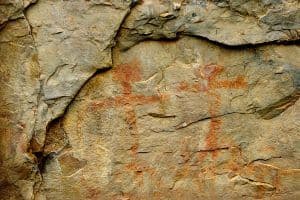
The first evidence we find of human presence in the Matarraña region is Levantine rock art. The first inhabitants of our territory left different artistic expressions in Cretas, Mazaleón and Beceite.
Under the generic title of Post-Palaeolithic rock art, several pictorial styles are known: schematic and Levantine, both represented in the Matarraña region. Within the classic Levantine style, animal figures are depicted in a naturalistic way, so that deer, bulls, goats… preside over the rock majestically, human beings in a resting or moving posture, that is, running, with archers being very common. The schematic style involves plastic representation with the minimum formal elements: men and animals are reduced to lines, with a symbolic-religious meaning.

Levantine rock art paintings as World Heritage

On 2 December 1998, UNESCO declared the Levantine rock art paintings of the Mediterranean Basin UNESCO World Heritage for constituting a unique and exceptional testimony of a disappeared civilisation. It is a narrative art, as these are first-hand documents that describe how the prehistoric peoples who preceded us lived.

Elements of rock art

Els Gascons (Cretas)

Els Gascons (Cretas)

This ensemble, together with that of "Roca dels Moros", inaugurates the era of Levantine art discoveries. It was discovered in 1908 by the French archaeologist Abbé Breuil in the gorge of Calapatar in Cretas.

The rock paintings were composed of two large naturalistically depicted deer superimposed, one in red and the other in black, accompanied by other animal representations such as goats, bovids and a horse. The novelty with respect to the neighbouring rock shelter of "Roca dels Moros" is the presence of the human figure, represented by four archers.

Currently only two naturalistic goats in black are preserved, with powerful horns, one in a resting posture, folded, and the other running. And part of an archer holding an arrow and bow aimed at one of the preserved goats, forming part of a hunting scene. They were removed and destroyed, and the negative of the extractions can be observed. The removal meant the destruction of most of the rock paintings preserved until then.
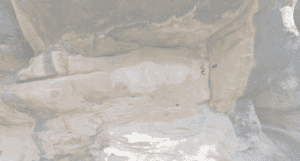
Roca dels Moros (Cretas)

Roca dels Moros (Cretas)

At La Roca dels Moros in Cretas, Juan Cabré discovered in 1.903 three beautiful naturalistically depicted deer in red that presided over the rock shelter majestically, accompanied by the figure of a bovid, and several human stylisations, discovering a new art called Levantine.

But the rock paintings had a poor fate, as, according to J. Cabré's account, a tile-maker intended to blast them in order to find a supposed treasure buried at the foot of the rock shelter, and with the intention of preserving the paintings, which until then had never been the object of vandalism, Cabré removed them. They are currently on display at the Archaeological Museum of Barcelona.

At present, alongside the marks of the extraction of the rock paintings, only two human stylisations are preserved to the right of the space occupied by the bovid, as well as the rear part of a cervid on the right wall, perpendicular to the removed panel. And also a Levantine archer and a quadruped, which would form a hunting scene.

Les Caigudes del Salbime (Mazaleón)

Les Caigudes del Salbime (Mazaleón)

In 1920, the secretary of Mazaleón, Lorenzo Perez Temprado, discovered in this rock shelter in the gorge of Les Caigudes del Salbime two scenes of prehistoric rock paintings.

Thousands of years after they were painted, in 1920, at the time of discovery, the rock shelter was formed by two facing panels joined at an angle. The left panel was composed of an archer and a naturalistically depicted female deer in red.

These rock paintings were removed at an imprecise moment after their study.

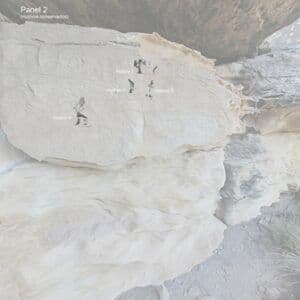
The right panel, still preserved though with very poor visibility, is composed of three human figures also in red of Levantine style according to the recent studies of M. Bea:

Motif 1 (legs) and motif 2 (upper half) would form part of a single human representation of which the medial area of the body would not have been preserved. Motif 3. Human representation with a tendency towards schematism oriented to the right. The head has a globular shape and the arms were depicted flexed and inwards ("en jarras").

Motif 4. This would correspond to a human figure oriented to the right and in a dynamic posture.

Paintings of La Fenellassa (Beceite)

Paintings of La Fenellassa (Beceite)

The rock shelter is located near the so-called Parrissal, in the heart of the Puertos de Beceite massif, in an open setting surrounded by pine forests where a kind of rocky outcrop stands out on the left bank of the Matarraña River. The rock paintings, which are fairly well preserved, were made on the north face of the limestone accumulation, right in front of a spring called La Fenellassa, from which the ensemble takes its name.

On the panel, up to twelve depictions of a markedly schematic style can be recognised, of which eight are identifiable. The red colour of the representations contrasts sharply with the yellowish tone of the rock surface, which, combined with the relatively good state of conservation of the rock paintings, allows the thematic content and scenic composition of the rock shelter to be identified.

This artistic style developed throughout the Iberian Peninsula from the Neolithic period and the early Metal Ages, and involves plastic representation with the minimum formal elements: men and animals are reduced to lines, with a symbolic-religious meaning.

Matarraña · Tourism

Plan your experience

Discover accommodation, local guides and services for your route through Matarraña.